
Dear Friends and Partners,
As I look back on this past year, what stands out most is the sense of momentum that has quietly taken hold across Helpful Engineering. It is the kind of momentum that comes from people staying engaged, asking better questions, and steadily turning shared intent into tangible progress.
2025 was a year of confidence-building and focus. We invested time in strengthening how we work so that what we build is not only thoughtful, but genuinely useful to those operating in the most challenging environments. That work has left us energized and optimistic about what lies ahead.
Building the Conditions for Impact
One of the most energizing milestones of the year was the launch of our Helpful Innovation Labs. These labs give our teams the structure and space to go deeper, collaborate more intentionally, and align our work more clearly with the UN Sustainable Development Goals. They allow us to explore ideas with rigor while staying grounded in the practical realities of humanitarian response.
Alongside this, we entered formal review to join the UN Global Compact. For us, this reflects a commitment to growing responsibly and holding ourselves to shared global standards around transparency, accountability, and long-term impact.
We also introduced the Helpful Challenge Framework, which has brought clarity to how challenges enter our pipeline and how multidisciplinary teams form around them. Our first Challenge, focused on Infectious Disease, helped center our work on a set of problems where speed, safety, and dignity must coexist. Just as importantly, it reinforced our commitment to listening. Across projects, teams engaged with clinicians, public health practitioners, and humanitarian operators to ensure designs are shaped by lived field realities rather than assumptions.
Spotlight on the Projects: Designed for the Field
Much of our work this year has centered on a growing portfolio of projects that share a common design philosophy. These efforts assume limited infrastructure, constrained resources, and rapidly changing conditions. They prioritize simplicity, adaptability, and thoughtful use of materials so that deployment in the field is always the guiding lens.
FlexContain Origami System

In outbreak and emergency settings, isolation capacity is often the first constraint to be reached and the hardest to expand. FlexContain explores how containment and isolation can be created quickly, safely, and without permanent construction. From a design perspective, the challenge is balancing rapid deployment with durability, cleanability, and human dignity. The system is being shaped to pack flat, deploy in minutes, and scale as needs evolve, offering responders a flexible tool when time and space are limited.
Helpful Water
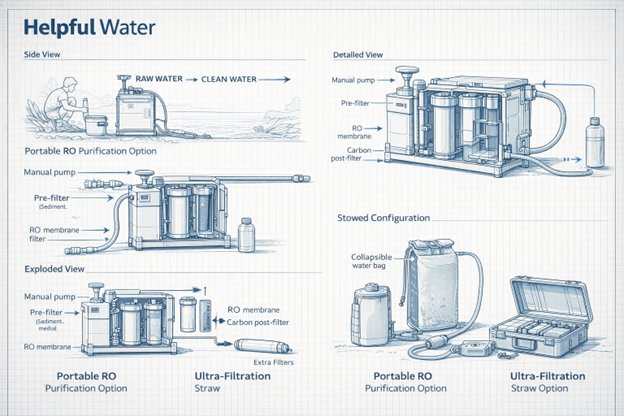
Access to clean water underpins nearly every aspect of health outcomes, yet in many crisis environments water systems are fragile, inconsistent, or absent altogether. Helpful Water tackles the challenge of providing reliable, modular water solutions that can adapt to varied contexts. The design focus centers on simplicity, maintainability, and resilience, ensuring systems can be deployed, repaired, and sustained with minimal dependence on complex infrastructure.
CleanAir Retrofit Kit

Poor air quality and inadequate ventilation are silent drivers of infection risk, particularly in crowded or enclosed spaces. The CleanAir Retrofit Kit addresses this by reimagining existing fans and duct systems as platforms for improved filtration and air treatment. The design challenge lies in working within what already exists, creating add-on solutions that are fast to install, easy to maintain, and practical in settings where full system replacements are not feasible.
FlexTriage Origami Bay

Triage is often improvised under pressure, using tape, tarps, or ad hoc barriers that offer little control over flow or contamination. FlexTriage focuses on creating rapidly deployable intake and assessment zones that bring order to chaos. From a design lens, the challenge is creating clear spatial cues, flexibility, and ease of setup while remaining lightweight and compact. The result is a system intended to support safer, more organized decision-making during outbreaks, mass casualty events, and sudden surges.
FlexClean Origami Decon Station

PPE removal and decontamination are among the highest-risk moments for healthcare workers, yet dedicated infrastructure is frequently missing in the field. FlexClean addresses the need for standardized, repeatable workflows that reduce exposure risk. The design effort centers on clarity and usability, embedding visual cues and logical sequencing directly into the physical space while remaining fast to assemble and easy to clean in austere conditions.
FlexSleep Origami Patient Pod

Overcrowding in emergency settings often forces patients into shared or exposed sleeping arrangements that compromise privacy, recovery, and infection control. FlexSleep explores how lightweight, foldable structures can create micro-boundaries within existing spaces. The design challenge is balancing airflow, visibility, and protection while maintaining a sense of dignity. The goal is to improve rest and recovery without introducing permanent or resource-heavy structures.
Individually, each of these projects addresses a specific gap. Together, they form a vision for an integrated field system that supports intake, transition, isolation, and recovery as a continuous flow. They share materials, folding logic, and deployment principles, allowing them to be used independently or as a coordinated whole. These concepts are still evolving, but they are being shaped with a clear focus on real-world use and practical impact.
Partnerships as a Force Multiplier in 2026
Looking ahead, we are excited about what deeper collaboration can make possible.
In 2026, we will be actively building partnerships across research, technical, and financial domains. Research partners help advance shared understanding and validate assumptions. Technical partners bring tools, facilities, and expertise that accelerate learning and prototyping. Financial partners provide the stability needed to carry promising ideas forward and responsibly scale impact.
Our approach is deliberate and transparent. We aim to align contributions with clear expectations, meaningful recognition, and long-term shared value. We believe humanitarian innovation works best when knowledge is shared, disciplines intersect, and trust is built over time.
If you are interested in exploring partnership opportunities with Helpful Engineering, we would welcome the conversation. Please reach out to us at [email protected] to begin a dialogue about how we might collaborate.
With Gratitude
This progress is made possible by people who bring care, persistence, and creativity to the work.
Lillian Fernandes and Raksha Thammaiah played a central role in bringing the Innovation Labs to life, translating vision into structure with focus and determination.
Amish Chadha with Michael Minn, and Ali Raza provided steady leadership as Program Leads, guiding teams through early design challenges and helping build momentum where uncertainty was high.
Barry Watkins strengthened our community through thoughtful recruitment and connection, ensuring that the right expertise found its way into the work.
Bhaveeni Parmar helped sharpen our governance and commercial thinking, bringing clarity and discipline at critical moments.
Andy Arluk brought consistent energy to promoting Helpful and expanding our partnership outreach, helping extend the reach of our mission.
To every volunteer, advisor, and partner who contributed time, insight, or trust this year, thank you. Your commitment continues to shape what Helpful can become.
Supporting the Work
As we look toward the year ahead, sustaining this work remains a shared effort.
Your support helps ensure we can keep the lights on while continuing to invest in projects that are gaining critical momentum. Donations allow us to move ideas from concept toward reality by supporting prototyping, testing, and the infrastructure required to keep teams moving forward. They give us the flexibility to respond where needs are greatest and where progress can have the most immediate impact.
This year, we also launched the Helpful SWAG Store as a new and tangible way to support our mission. Every item purchased helps fund project prototyping and brings visibility to the work our community is building together. If you are curious, we encourage you to take a look and share it with others who believe in this mission:
👉 https://helpful.getgivee.com/products
For those interested in contributing directly, there are several ways to support Helpful Engineering:
- General donations, which help sustain operations and project momentum, can be made here:
👉 https://tinyurl.com/Helpful-Donation - Project-specific funding, supporting teams and initiatives directly, is available through Open Collective:
👉 https://opencollective.com/helpful
Every contribution, large or small, helps turn collective intent into real-world progress. We are deeply grateful for your support and belief in what this community can build together.
Looking Ahead
As we move into 2026, we are expanding our teams across active projects and are actively recruiting contributors in the following areas:
- Project Leads
- CAD Designers
- Material Science Engineers
- Mechanical Engineers
- Product Designers
- Public Health Specialists
- Hydraulics Specialists
If you are interested in contributing in any one of these roles, have project ideas of your own or have other technical skills you’d like to offer please reach out to [email protected].
We are also looking forward to launching the next cohort of Helpful Internships in Spring 2026. These internships will offer emerging talent the opportunity to work alongside experienced practitioners on real humanitarian challenges, gaining hands-on experience while contributing meaningfully to the work. Stay tuned for more updates as we build out the program.
There is real momentum heading into the new year. There are ideas ready to be tested, partnerships waiting to be built, and meaningful work ahead.
Thank you for being part of this journey. We are excited about the future we are building together.
With appreciation,
James Butler
CEO, Helpful Engineering


